Universe and cosmology Galaxies and the Milky Way
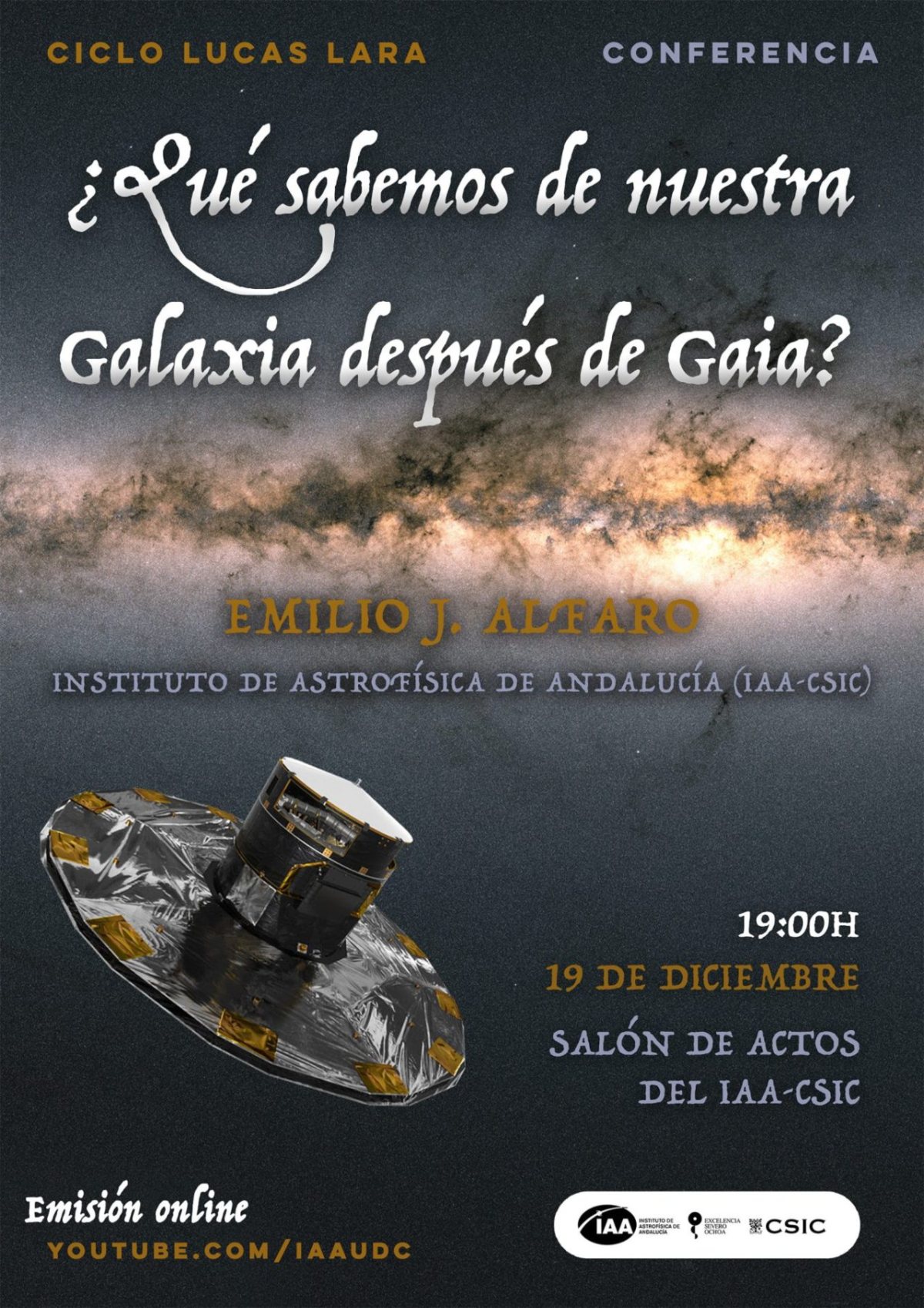
What do we know about our Galaxy after Gaia?
Emilio J. Alfaro Institute of Astrophysics of Andalusia
The video loads from YouTube (privacy-enhanced mode) only when you press play.
About the lecture
Over the last 11 years, the results of the Gaia mission have revolutionised our knowledge of the Milky Way, offering an unprecedented level of detail. This space observatory has mapped with extreme precision the positions, motions and photometry of more than 1.8 billion stars, providing a three-dimensional view of our galaxy. Thanks to Gaia, we now better understand the spiral structure of the Milky Way, star formation processes and gravitational interactions with other nearby galaxies.
The data have revealed surprising ripples in the galactic disc, probably caused by encounters with satellite galaxies such as Sagittarius. They have also made it possible to identify star clusters, stellar streams and motion patterns that tell us the dynamic history of the Galaxy. In addition, Gaia has significantly improved our measurements of stellar distances and masses, which directly leads to a better understanding of stellar evolution.
In essence, Gaia has not only transformed astrophysics but has allowed humanity to explore its galactic home more clearly, opening new questions and challenges in our quest to understand the cosmos.
Text of the official description published by IAA-CSIC on YouTube.