Observing the cosmos: telescopes and missions Space and society
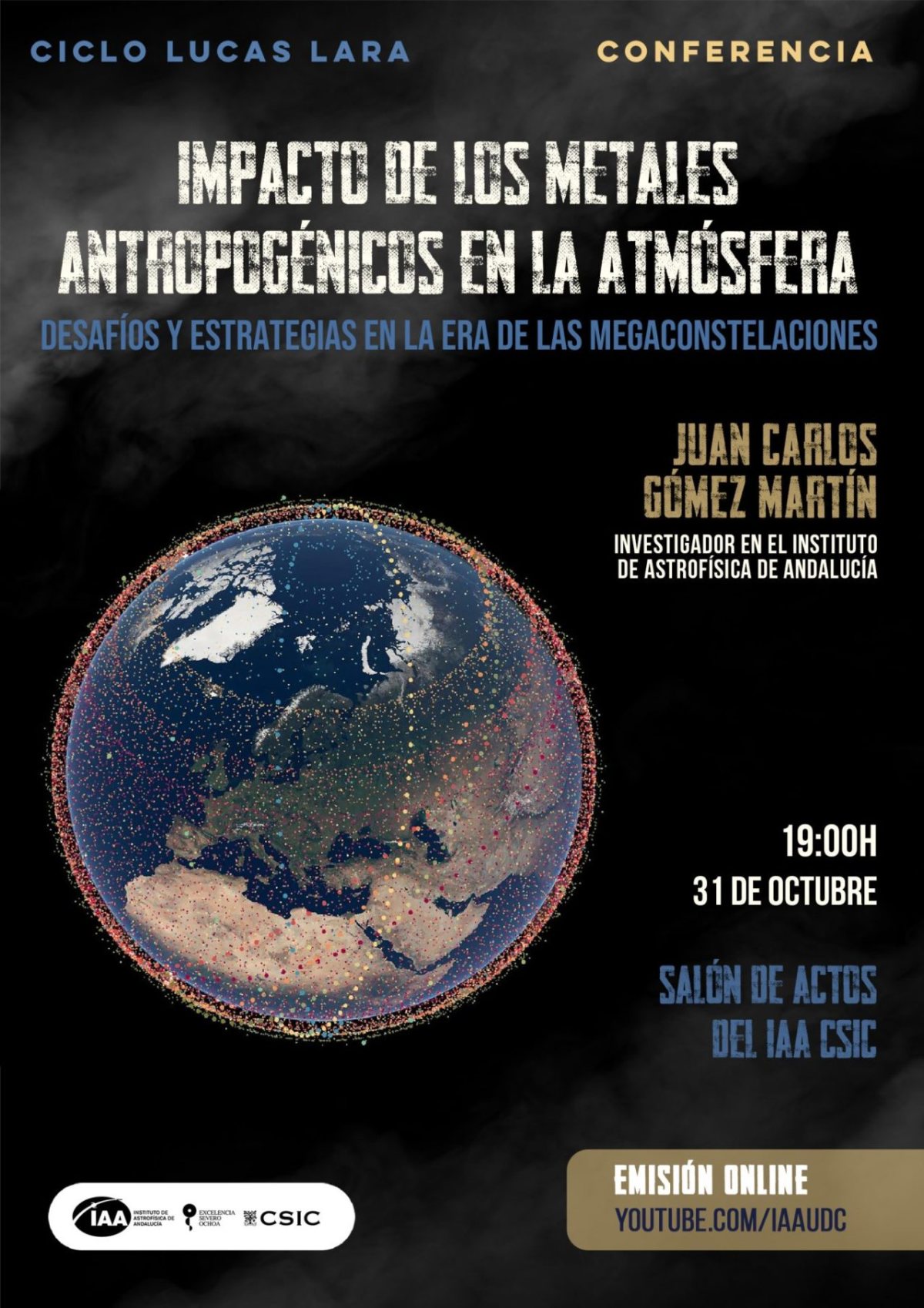
Impact of Anthropogenic Metals on the Atmosphere: Challenges and Strategies in the Era of Megaconstellations
Juan Carlos Gómez Martín Cosmic Dust Laboratory · Institute of Astrophysics of Andalusia
The video loads from YouTube (privacy-enhanced mode) only when you press play.
About the lecture
In the coming decades a significant increase is expected in the number of satellites in low Earth orbit, driven mainly by the growth of broadband telecommunications megaconstellations. Space agencies' 'zero debris' strategy aims to avoid generating large amounts of space debris through the planned disintegration of used vehicles and inactive satellites in Earth's atmosphere. However, this strategy has raised concerns in the scientific community about the possible environmental impacts of the metals injected into the atmosphere, especially on the stratospheric ozone layer. In fact, recent measurements show that 10% of stratospheric sulphate particles already contain exotic metals used by the aerospace industry.
In this talk we will review projections of spacecraft re-entries into the atmosphere over the next decade, the debris reduction strategy proposed by the European Space Agency, and the expected increase in metals injected into the atmosphere, both as gas and as microparticles. We will also explore the potential chemical effects of anthropogenic metals in the mesosphere and stratosphere, using as a reference the chemistry of meteoric metals, which are naturally present in the atmosphere and produce a surprising variety of atmospheric phenomena. Finally, we will highlight how experimental research can guide agencies and the aerospace industry in improving their strategies and mitigating their impacts.
Text of the official description published by IAA-CSIC on YouTube.